
Africa’s AI health opportunity will depend on the science behind the technology
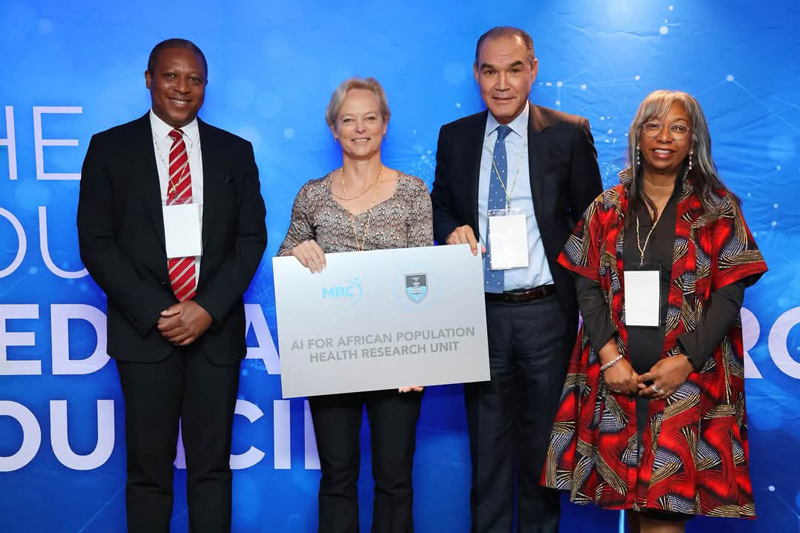
Pictured from left are Prof Ntobeko Ntusi, president and CEO of the SAMRC; Prof Nicola Mulder, head of the new SAMRC/UCT AI for African Population Health Unit; Prof Tyrone Pretorius, chairperson of the SAMRC; and Prof Liesl Zühlke, vice-president of Extramural Research and International Portfolio at the SAMRC. Photo: SAMRC
Artificial intelligence is increasingly influencing how researchers investigate disease, interpret biological information and assess potential treatments. For Africa, however, the central question is not simply how quickly these technologies can be adopted, but whether the continent has the scientific capacity to develop solutions that reflect its own health priorities.
A new research initiative involving the South African Medical Research Council (SAMRC) and the University of Cape Town (UCT) is seeking to strengthen that capacity, bringing together computational biology, clinical research and machine learning to investigate diseases affecting African populations.
The AI for African Population Health Unit, based within UCT’s Faculty of Health Sciences, began operating in August 2026. Led by Professor Nicola Mulder, the initiative forms part of a wider SAMRC investment in strategic health research, with seven new extramural research units announced in July.
Its significance extends beyond the development of new algorithms. The initiative reflects a growing need for African research institutions to combine biological knowledge, locally relevant data and advanced computing capabilities to generate evidence that can inform healthcare decisions.
Why local research matters
AI applications in healthcare rely on the quality and relevance of the information used to develop them. Differences in patient populations, disease prevalence and clinical environments can influence how well a model performs when applied beyond its original setting.
For African researchers, this creates an opportunity to develop approaches grounded in the continent’s own biomedical and clinical evidence.
The new unit intends to investigate how machine learning can support the identification of disease biomarkers, improve diagnostic accuracy and strengthen risk assessment. Its research priorities include non-communicable diseases such as cancer, diabetes and cardiovascular disease, alongside infectious diseases including tuberculosis, HIV and malaria.
Researchers will work with different forms of biomedical and clinical data to examine disease mechanisms and relationships between conditions. Such approaches could contribute to a more detailed understanding of how diseases develop and how diagnosis and treatment might be improved for different patient populations.
The practical value of this work will ultimately depend on scientific validation and its ability to inform clinical practice. Research findings must be tested rigorously before AI-based tools can be relied on in patient care.
Nevertheless, developing locally relevant research capabilities is an important step towards ensuring that African populations are adequately represented in the scientific evidence shaping future healthcare technologies.
Connecting disciplines to solve complex problems
The growing complexity of biomedical research has made collaboration between disciplines increasingly important.
At UCT, the new unit will draw on existing expertise in computational biology, biomedical imaging, proteomics and infectious disease research. Its links to clinicians and research facilities within the Faculty of Health Sciences and the Institute of Infectious Disease and Molecular Medicine provide a foundation for combining computational analysis with biological and clinical knowledge.
Professor Mulder brings experience in molecular biology, bioinformatics and pan-African research capacity development. Her work has included supporting initiatives that strengthen bioinformatics expertise across the continent, as well as managing an open data science platform associated with the DS-I Africa consortium.
The unit also includes mid-career researchers Dr Musalula Sinkala and Dr Hocine Bendou, whose work applies data science to biomedical research.
This combination of expertise is relevant to a field in which technological development alone is insufficient. Researchers must understand the underlying biology, assess the quality of the data and determine whether computational findings have meaningful scientific or clinical implications.
Access to UCT’s computing facilities will support the analysis of complex datasets, while collaboration with clinicians and biomedical scientists can help connect research questions to practical healthcare needs.
Developing Africa’s scientific talent
A further consideration is whether investment in AI research can create lasting scientific capacity.
The new unit plans to support postgraduate students through training in interdisciplinary research, with particular attention to students from historically disadvantaged backgrounds. Its programme will also seek to strengthen collaboration between emerging researchers and established academics.
This is important as healthcare research increasingly requires skills that span biology, statistics, computing and data interpretation.
Developing these capabilities within African institutions could help expand the continent’s contribution to international scientific research and reduce reliance on expertise developed elsewhere. It could also enable researchers to pursue questions that reflect local disease burdens and healthcare priorities.
The unit’s leadership has identified the development of future researchers and academic leaders as a key objective, alongside producing research that advances understanding of African health challenges.
Ethics will form part of this work. The use of health data and AI in medical research requires careful consideration of privacy, responsible data governance, representation and the reliability of results. These issues become particularly important when technologies are intended to inform decisions affecting diverse populations.
Measuring the return on research investment
The SAMRC–UCT initiative is part of a broader network of 30 extramural research units supported by the medical research council. The programme connects research activity across universities, scientific institutions and other research organisations.
For the healthcare sector, the longer-term opportunity lies in whether this investment can generate findings that translate into measurable improvements in disease detection, clinical assessment and treatment.
That transition requires more than scientific publications or functioning AI models. It depends on validation, collaboration with healthcare professionals and the ability to establish whether new approaches work in real clinical environments.
Professor Liesl Zühlke, the SAMRC’s vice-president of Extramural Research and International Portfolio, has welcomed the unit as part of efforts to use AI to improve health outcomes in South Africa and across Africa.
The initiative also highlights the importance of sustained investment in people and infrastructure. Advanced analytical tools can support new discoveries, but researchers need appropriate computing resources, access to relevant data and opportunities to work across disciplines to realise their potential.
Africa’s ability to benefit from AI in healthcare will therefore depend not only on adopting emerging technologies, but also on building the research systems needed to develop, test and apply them responsibly.
The establishment of the UCT-based unit offers one example of how local institutions are seeking to build that foundation. Its eventual impact will be measured by the quality of the science it produces, the researchers it develops and the extent to which its findings contribute to better health outcomes for African populations.